
App Developers Near Me
Trusted by businesses across India, the UK, and the USA.
If you are looking for app developers near me in Haldwani to generate more leads, improve your online presence, or scale your marketing campaigns effectively, our team can help you achieve measurable results.
From SEO and performance marketing to branding, campaign management, and marketing strategy consulting, we work with businesses to identify growth opportunities and implement marketing solutions that deliver real impact.
Connect with us to explore how the right digital marketing strategy can accelerate your business growth.
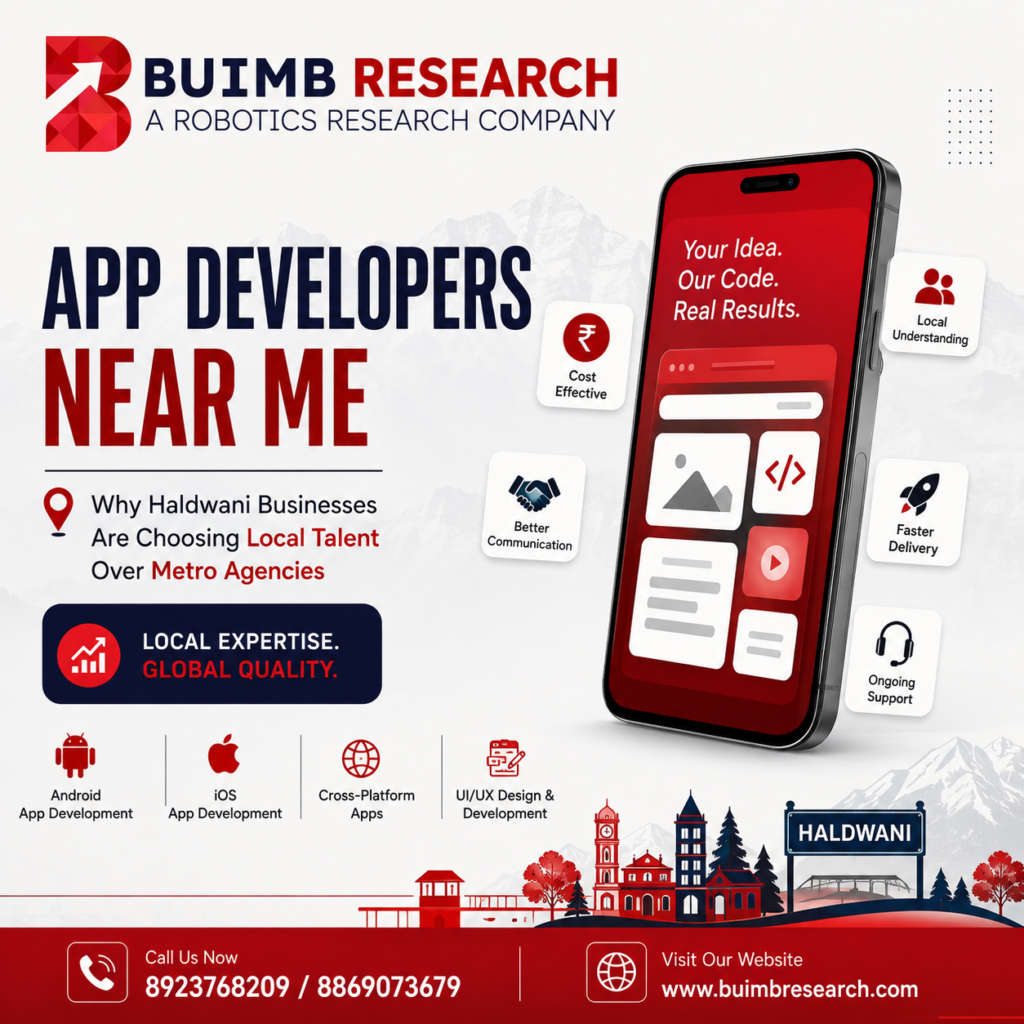
App Developers Near Me: Why Haldwani Businesses Are Choosing Local Talent Over Metro Agencies
A few years ago, if a Haldwani business wanted a mobile app built, there was really only one option: hire an agency in Delhi, Bengaluru, or Gurugram, and get used to email delays, video-call scheduling across busy calendars, and quotes in numbers that felt disconnected from local reality. You’d send a brief, wait days for a proposal, negotiate over email, and hope the final product actually matched what you had in mind when you started.
This shift isn’t just happening in Haldwani—it’s part of a larger transformation across India’s tier-2 and tier-3 cities, where the belief that “real talent lives in metros” is steadily fading. This blog explores what’s driving this change, why businesses are increasingly choosing app developers near me in Haldwani, and how working with local talent could be the smarter choice for your business.
Connect with us to explore how the right digital marketing strategy can accelerate your business growth.
A Quick Look Back: How We Got Here
For roughly two decades, India’s tech and digital talent was heavily concentrated in a handful of cities — Bengaluru, Hyderabad, Pune, Mumbai, Delhi-NCR, and Chennai. If you wanted a website, an app, or any kind of serious digital work done, you went to one of these cities, or you settled for whatever local resources happened to be available, which were often limited and inconsistent.
This wasn’t an accident. Engineering colleges, IT parks, venture capital, and corporate headquarters were all clustered in metros, which created a self-reinforcing cycle: talent moved to metros because that’s where the jobs were, and jobs stayed in metros because that’s where the talent was. Small-town and tier-2 city businesses were left with two options — pay a premium for a metro agency, or make do with whatever local freelancer they could find, often with mixed results.
That cycle is finally breaking. Improved internet infrastructure, the rise of remote work culture, rising costs of living in metros, and a new generation of engineering and design graduates choosing to build careers closer to home have all combined to create something that didn’t really exist ten years ago: a genuinely capable, growing pool of local tech talent in cities like Haldwani.
The Bigger Picture: Why “App Developers Near Me” Searches Are Rising Beyond Metros
For over a decade, “hiring a developer” meant hiring someone in a metro city — that was simply where the talent, infrastructure, and client trust were concentrated. That assumption no longer holds, and it’s exactly why searches for app developers near me have grown steadily across smaller Indian cities — the numbers back this shift up clearly.
Nationally, a meaningful and growing share of India’s tech workforce is now based outside the traditional metro hubs, spread across cities that offer strong academic institutions, improving infrastructure, and expanding local industry clusters. Hiring in these regional markets increasingly relies on localised strategies — campus partnerships with nearby engineering colleges, digital-first recruitment, and community networks — rather than simply extending old metro hiring playbooks to a new zip code.
At the same time, internet penetration in tier-2 and tier-3 cities is expanding at nearly double the rate of already-saturated metro markets. Non-metro regions now account for the majority of India’s active internet users, and rural internet usage is growing at multiple times the pace of urban India. Nearly all Indian villages now have reliable 4G or 5G connectivity, effectively closing what used to be called the “digital divide” and leaving only what analysts now call the “opportunity gap” — meaning the infrastructure exists, and it’s now a question of who builds the products and services to serve these markets.
This shift isn’t limited to consumption either. Tier-2 and tier-3 cities are increasingly becoming production hubs too — for logistics, e-commerce fulfilment, business process outsourcing, and yes, software and app development. Even India’s Global Capability Centre ecosystem, historically dominated by six major metro cities, is beginning to adopt a “hub-and-spoke” model where smaller cities take on real development work rather than just back-office support.
For Haldwani specifically, this means the local digital ecosystem — from app developers to digital marketers — isn’t a small, improvised alternative anymore. It’s part of a genuine national shift in where skilled tech talent is choosing to build careers and businesses, and Haldwani business owners searching “app developers near me” today are tapping into that shift, whether they realise it or not.
Why Haldwani Businesses Search “App Developers Near Me” Instead of Metro Agencies
It’s not just that local talent is becoming available — businesses are actively choosing it over metro agencies, for very practical, financially sound reasons. Let’s break each one down.
1. Cost Without the Metro Markup
Metro agencies typically carry significantly higher operational costs — commercial office rent in Bengaluru or Gurugram, larger salaried teams, account managers, sales staff, and general overhead — and all of that gets baked into every client quote, whether the client needs it or not. Businesses relocating operations to tier-2 cities are already reporting cost savings of up to 50% compared to metro markets on comparable services, and that same arbitrage applies directly to hiring an app developer.
A Haldwani-based developer generally doesn’t carry that same overhead structure. This is one of the biggest reasons app developers near me consistently quote more realistic numbers than metro agencies — they’re not paying metro commercial rent, they’re often running leaner teams, and they don’t need to charge a premium just to cover a large agency’s operating costs. The result is usually more realistic, transparent pricing — pricing that reflects the actual work being done, not the cost of maintaining a fancy office in a expensive city.
This doesn’t mean local always means “cheap” in a way that compromises quality. It means the pricing structure is more aligned with what small and medium Haldwani businesses can realistically invest, without artificially inflated markups that exist purely because of a metro address.
2. Communication That Actually Works
Anyone who has worked with a distant vendor knows the specific frustration of email delays, scheduled calls that get pushed, and the general friction of coordinating with a team that operates on its own timeline. With a metro agency, you’re often one client among dozens, and your priority level in their queue may not match your own sense of urgency.
A local developer changes that dynamic completely. There’s no time-zone confusion (a non-issue domestically, but a real friction point if you’ve ever worked with an overseas team), no “we’ll circle back by end of week” delays, and no account manager acting as a middleman between you and the person actually doing the work. A local developer can hop on a call — or meet you in person at their office or yours — the same day, which matters enormously when you’re mid-project and need a quick decision made on design, functionality, or budget.
This immediacy compounds over the life of a project. A two-week delay caused by slow communication on a metro project can turn into a two-month delay by the time you factor in every revision cycle, approval, and clarification. Local proximity eliminates most of that friction entirely.
3. They Understand Your Actual Customer
A developer sitting in Bengaluru is, consciously or not, building for a Bengaluru user by default — different digital habits, different payment preferences, different assumptions about internet speed, device type, and language. That’s not a criticism of their skill; it’s simply a reflection of the environment they’re immersed in every day.
A Haldwani-based developer already understands Hinglish search behaviour, UPI-first payment expectations (UPI has become the default transaction method for the large majority of consumers in non-metro markets), and how Kumaon customers actually browse and buy — because they see it every day, not because they read about it in a market research report. This shows up in small but meaningful design decisions: how forms are labelled, what payment options are prioritised, how navigation is simplified for users who may be more comfortable with WhatsApp than complex app interfaces, and how content is written to match actual regional search behaviour rather than generic templates.
4. Accountability You Can Actually Enforce
If a metro agency misses a deadline, your realistic options are limited to emails, follow-up calls, and hoping your account manager escalates the issue internally. There’s no real leverage beyond your contract and your patience.
If a local developer misses a deadline, you can walk into their office. That single difference — the ability to physically show up and have a direct conversation — changes how seriously a project gets treated on both sides. It’s harder to deprioritise a client you might run into at a local business event or a shared vendor’s shop than one who exists only as an email thread.
This accountability also works in reverse: a local developer knows that poor work or missed commitments will travel fast within a tight-knit local business community, which creates a strong incentive to deliver consistently, not just on the first project but on every referral that follows.
5. Genuine Investment in Local Business Growth
Local developers often build their entire client base and reputation through word-of-mouth within the Haldwani business community — one satisfied client leading to the next referral, one well-reviewed project building the foundation for the business’s own growth. That structure creates a strong, ongoing incentive to deliver quality work and maintain long-term relationships, because their business literally depends on it.
A metro agency, by contrast, may treat a small-town client as a relatively minor project among hundreds of larger accounts — a Haldwani retailer’s app project simply doesn’t carry the same weight internally as a larger metro client’s contract, and that can (even unintentionally) affect prioritisation, responsiveness, and how much senior attention the project actually receives.
When a Metro Agency Might Still Beat App Developers Near Me
To be fair, local talent isn’t automatically the right choice for every project, and it’s worth being honest about that rather than overselling the local angle. Very large-scale, highly specialised builds — think enterprise-grade platforms with complex regulatory compliance requirements, large distributed engineering teams, or deep specialisation in a narrow technical niche — may still benefit from the broader bench strength, specialised expertise, and larger delivery capacity that a big metro agency can offer.
If your business needs a platform handling millions of transactions, multi-region compliance, or highly specialised AI infrastructure, a larger, more specialised team may genuinely be the better fit, regardless of location.
But for the vast majority of Haldwani businesses — retailers, travel agencies, restaurants, clinics, educational institutes, and service providers — that level of complexity simply isn’t the requirement. A capable local team is more than sufficient for these needs, and is often the smarter, more responsive, and more cost-effective choice precisely because the project doesn’t require metro-scale infrastructure to begin with.
What to Look for When Hiring App Developers Near Me in Haldwani
Choosing “local” alone isn’t a strategy — proximity solves communication and cost friction, but it doesn’t automatically guarantee skill or reliability. You still need to vet properly, the same way you would with any vendor:
- Ask for a real portfolio, not just design mockups. Request to see actual working apps, ideally ones still live and in use, not just polished screenshots.
- Get a written quotation with a clear scope breakdown — design, development, testing, deployment, and any recurring maintenance costs spelled out separately, not bundled into a vague lump sum.
- Confirm post-launch support terms before signing anything. Ask specifically how bug fixes, OS updates, and future feature requests will be handled once the app is live.
- Check communication responsiveness during the sales conversation itself — how quickly and clearly they respond before you’ve paid anything is usually a fairly accurate preview of what working together will actually look like.
- Ask about ownership of source code, design files, and app store developer accounts after project completion. This should be clearly stated in writing, not left as an assumption.
- Look for evidence of local understanding, not just technical capability — ask how they’d approach a Hinglish-speaking user base, or how they’d design for UPI-first payment flows, and see how thoughtful the answer is.
Common Myths About App Developers Near Me, Addressed
“App developers near me are less skilled than metro agencies.” This assumption is increasingly outdated. Skilled developers today can access the same learning resources, frameworks, and tools as anyone in a metro city — the internet has largely levelled the technical playing field. What varies is experience and portfolio, not geography, which is exactly why vetting matters more than the address on a business card.
“Local means cheaper but lower quality.” Lower overhead does often mean lower pricing, but that’s a function of business cost structure, not a reflection of the quality of work being delivered. A well-vetted local developer can deliver output on par with a metro agency, simply without the added markup for office rent and large administrative teams.
“There aren’t enough local options to compare.” This was truer a few years ago. As tier-2 city tech ecosystems have grown, the pool of legitimate local options has grown with it — which is exactly why proper vetting (portfolio, references, written scope) matters more now than ever, to separate serious local developers from inexperienced freelancers riding the trend.
The Bottom Line on App Developers Near Me in Haldwani
Haldwani businesses aren’t choosing local talent out of loyalty or convenience alone — they’re choosing it because, for most projects, it’s genuinely the more practical option: lower cost without a metro markup, faster and more direct communication, a better built-in understanding of the local customer, and real, enforceable accountability. As India’s tech talent continues spreading beyond the traditional metro hubs, this shift is only going to accelerate — and Haldwani businesses that tap into local talent early are positioning themselves ahead of the curve, not behind it.
References
- TeamLease — Hiring Trends in India: The Rise of Tier 2 and Tier 3 Cities
- Outsource Accelerator — India’s Tier-2 Cities Emerge as Cost-Effective Talent Hubs
- Indujitechnologies — Why Tier 2/3 Cities Drive India’s Digital Growth in 2026
- EFC India — Managed Office Space Tier-2 India: A 2026 Growth Story
- KPMG India — Growth Beyond Metros: The Rise of Tier-2 and Tier-3 Cities
- Astravise Services — 2026 Innovation Hubs: The Rise of Tier-2 Cities
Connect with us to explore how the right digital marketing strategy can accelerate your business growth.
Q1: Are app developers near me in Haldwani actually as skilled as metro agencies?
Skill depends on the individual or team, not the city they’re based in. Developers everywhere now have access to the same frameworks, tools, and learning resources. The real differentiator is experience and portfolio — which is why checking past work matters more than checking the
Q2: Will hiring locally actually save money, or is that just a perception?
It’s a real, measurable effect in most cases. Metro agencies carry higher operational costs — office rent, larger teams, account management layers — that get built into client pricing. Local developers typically don’t carry that same overhead, which often results in more realistic quotes for comparable work.
Q3: How do I know if a local Haldwani developer is legitimate and not just an inexperienced freelancer?
Ask for a real, working portfolio (not just mockups), request client references if possible, insist on a written scope and quotation, and pay attention to how clearly and promptly they communicate before you’ve even signed anything — that’s usually a preview of the working relationship ahead.
Q4: Is it risky to hire a smaller local team instead of a big agency?
Every vendor carries some risk, regardless of size or location. The way to manage it is the same either way: a clear written contract, defined milestones, and confirmed ownership of source code and app store accounts after launch — not the size of the company’s office.
Q5: What if my project is genuinely complex — should I still consider local talent?
For most small and medium business apps (booking, catalog, payments, basic AI features), local talent is more than capable. For very large-scale, highly specialised, or heavily regulated platforms, a bigger agency with deeper bench strength may be worth considering — but that applies to a small minority of projects, not the typical Haldwani business app.