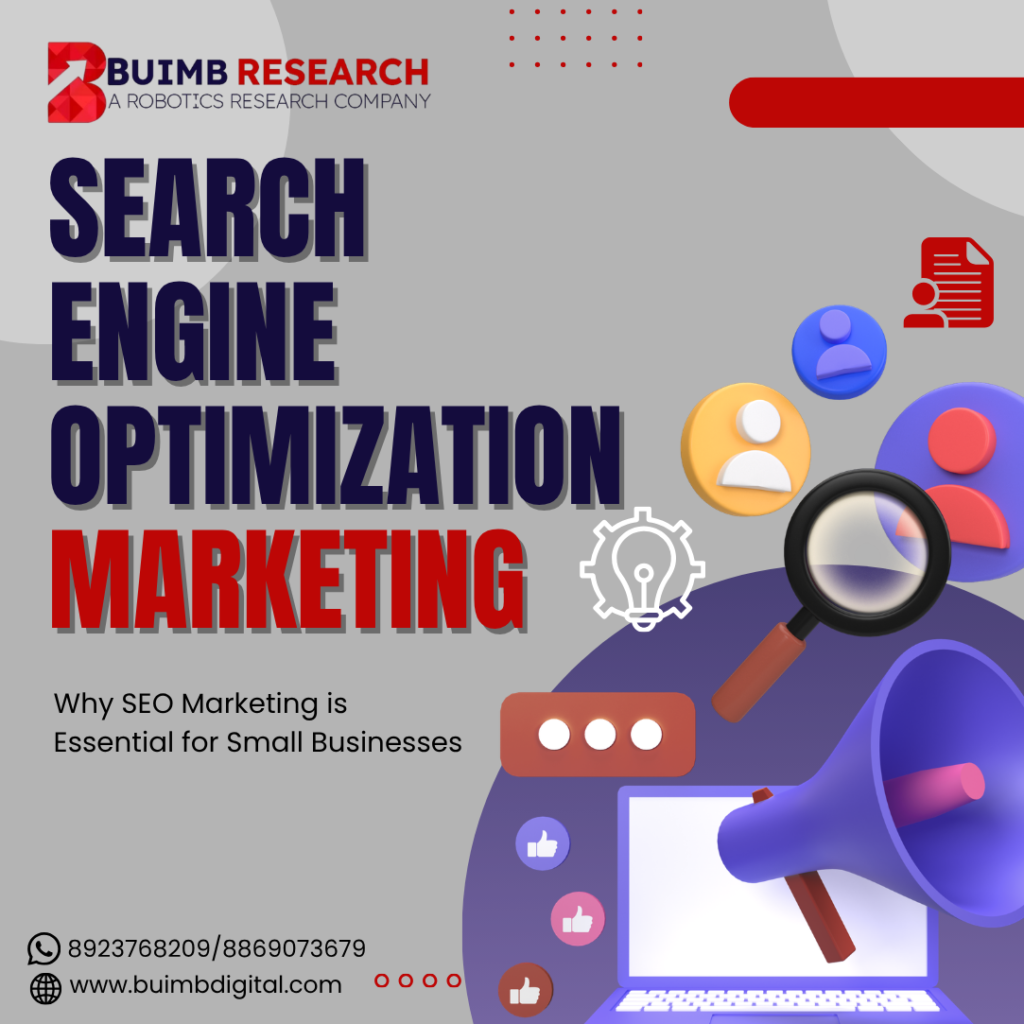
Why SEO Marketing is Essential for Small Businesses
Trusted by businesses across India, the UK, and the USA.
If you are looking to generate more leads, improve your online presence, or scale your SEO marketing campaigns effectively, our team can help you achieve measurable results.
From SEO and performance marketing to branding, campaign management, and marketing strategy consulting, we work with businesses to identify growth opportunities and implement marketing solutions that deliver real impact.
Connect with us to explore how the right digital marketing strategy can accelerate your business growth.
Why SEO Marketing is Essential for Small Businesses
If you own a small business and you’re not showing up on Google, you’re not just missing “extra” traffic — you’re missing the majority of your potential customers. SEO marketing is the process of optimizing your website so it ranks higher on search engines for the exact terms your customers are already typing in. And in 2026, it has quietly become the single most cost-effective growth channel available to small businesses — more reliable than ads, more durable than social media trends, and far cheaper over time.
In this guide, we’ll walk through exactly why SEO marketing matters for small businesses, back it up with real 2026 data (including India-specific numbers), and give you a practical roadmap to get started — the same one our team at BUIMB Digital Marketing uses with clients.
Connect with us to explore how the right digital marketing strategy can accelerate your business growth.
What Does SEO Marketing Actually Mean?
SEO marketing (Search Engine Optimization marketing) is the combination of technical, content, and authority-building strategies used to help a website rank higher in organic (unpaid) search results. Unlike pay-per-click advertising, where visibility disappears the moment you stop paying, SEO marketing compounds — the work you do today keeps generating traffic and leads months, even years, later.
For a small business owner, this distinction isn’t academic. It’s the difference between renting visibility and owning it.
1. Organic Search Still Drives the Most Website Traffic
It’s easy to assume Instagram, Facebook, or paid ads bring in most online traffic today. The data says otherwise. Organic search consistently accounts for roughly 53% of all trackable website traffic globally — more than direct traffic, social media, and paid search combined in most industries (BrightEdge, 2026; WordStream, 2026).
That means more than half of the people who could become your customers are finding businesses like yours through a simple Google search — not a scroll through social media. If your business isn’t ranking, you’re invisible to that entire pool of buyers before they ever reach your Instagram page or your ad.
2. SEO Marketing Delivers the Strongest Long-Term ROI
Paid ads can generate quick traffic, but costs rise every year and the traffic vanishes the moment your budget runs out. SEO marketing works on a completely different curve. Industry benchmarking research puts the median ROI of SEO at approximately 748% over a three-year period, making it one of the highest-return marketing channels available to any business, let alone a small one operating on a tight budget (xpanddigital.io, 2026).
What makes this especially relevant for small businesses is compounding: a blog post or optimized service page you publish today can keep bringing in leads for years, without additional ad spend. That’s a very different economics model than paid media.
3. Most of Your Competitors Are Already Investing in SEO
Here’s a number that should make you pause: roughly 74% of small businesses already invest in SEO marketing in some form, spending an average of a few hundred dollars a month on it (AIOSEO, 2026). If your competitors are ranking on page one and you’re not, there’s a good chance they’ve already made this investment — and you haven’t.
The encouraging part is that SEO marketing remains one of the few channels where a smaller, sharper, more consistent business can still outrank a bigger competitor with a bigger budget — particularly at the local and regional level, where authority is easier to build.
4. Local Search is a Massive Opportunity for Small Businesses (Especially in India)
If you run a local business — a clinic, an agency, a retail store, a service provider — local SEO marketing matters more than almost anything else you can invest in. Local intent searches (queries containing “near me,” a city name, or a neighborhood) account for close to 46% of all mobile Google searches in some markets (BrightEdge, 2026).
This is even more pronounced in India, where over 700 million internet users are now online and digital adoption among small and medium businesses continues to accelerate rapidly (Maya Digital Desk, 2026). For a business based in a city like Haldwani, Dehradun, or anywhere in Uttarakhand, this means someone searching “digital marketing agency near me” or “best [service] in [city]” is a warm, ready-to-convert lead — and local SEO marketing is what decides whether they find you or your competitor.
Local SEO also increasingly overlaps with Answer Engine Optimization (AEO) — structuring content so it gets pulled directly into Google’s AI Overviews, featured snippets, and “People Also Ask” boxes, which is becoming a critical ranking factor for Indian businesses in 2026 (Kodetimize, 2026).
5. Ranking #1 on Google Captures Nearly 40% of All Clicks
Ranking on page one isn’t just a vanity metric — it’s where almost all the traffic actually goes. The #1 organic result on Google captures close to 40% of clicks for a given query, while results further down the page receive a fraction of that traffic (BizIQ, 2026).
This is the core reason SEO marketing isn’t about simply “having a website.” It’s about being positioned exactly where your buyers are already looking. A website sitting on page three of Google might as well not exist for most searchers — 96.55% of all published web pages currently receive zero organic traffic from Google at all (BizIQ, 2026), which shows just how big the gap is between businesses doing SEO marketing correctly and those that aren’t.
6. SEO Marketing Builds Trust That Ads Can’t Buy
Consumers instinctively trust organic search results more than paid ads — ranking naturally signals that your business is established, relevant, and credible in a way a sponsored listing simply can’t replicate. Over time, consistent SEO marketing also strengthens your site’s overall authority, making it progressively easier to rank for even more competitive, higher-value keywords in your industry.
This trust compounds with something called E-E-A-T — Experience, Expertise, Authoritativeness, and Trustworthiness — which is how Google evaluates whether content deserves to rank. Real author bios, cited data, genuine case studies, and transparent business information (like an address, GSTIN, or LLP registration) all feed into this signal, which is part of why we include our own credentials and sources throughout this blog.
7. It Works Around the Clock, Without Extra Spend
Once a page starts ranking for the right keywords, it keeps generating visibility and leads continuously — nights, weekends, slow seasons, all of it — without any additional spend. This is the compounding advantage of SEO marketing: unlike a billboard or a short-lived ad campaign, your rankings keep working quietly in the background, bringing in potential customers long after the work is done.
How Small Businesses Can Get Started with SEO Marketing
If you’re a small business owner wondering where to begin, here’s a practical roadmap — and a closer look at what each step actually involves.
1. Keyword Research
Before writing a single page, you need to know exactly what your potential customers are typing into Google. This means identifying high-intent keywords — searches that signal someone is actively looking to buy, book, or hire, not just casually browsing.
For most small businesses, this means a mix of:
- Short, high-volume keywords (e.g., “digital marketing agency”) — competitive but high-value.
- Long-tail keywords (e.g., “affordable digital marketing agency in Haldwani”) — lower competition, higher conversion intent.
- Question-based keywords (e.g., “how much does SEO marketing cost for a small business”) — great for capturing people still researching.
Free tools like Google Keyword Planner or Google Search Console are a solid starting point; the real skill lies in choosing keywords that balance search volume with genuine buyer intent, rather than chasing traffic for its own sake.
2. On-Page Optimization
Once you know your target keywords, the next step is structuring your website around them correctly. On-page SEO marketing includes:
- Writing keyword-optimized, click-worthy title tags and meta descriptions.
- Using a clear heading structure (H1, H2, H3) so both readers and search engines can follow your content easily.
- Naturally weaving keywords into your content, image alt text, and URL slugs — without stuffing.
- Improving readability with short paragraphs, bullet points, and internal links to related pages.
This is often the fastest win for small businesses, since it doesn’t require new content — just optimizing what already exists.
3. Local SEO
For most small businesses, local customers are the core of the business — which makes local SEO one of the highest-impact parts of any SEO marketing strategy. This includes:
- Claiming and fully optimizing your Google Business Profile, with accurate hours, categories, photos, and services.
- Building consistent local citations — your business name, address, and phone number (NAP) listed identically across directories.
- Actively collecting and responding to customer reviews, which directly influence both rankings and trust.
- Creating location-specific landing pages if you serve multiple cities or regions.
4. Content Marketing
Search engines consistently reward websites that publish helpful, relevant content — and so do customers. A solid content marketing plan includes:
- Blog posts (like this one) that directly answer questions your customers are actually asking.
- Service pages that go deep into specific problems you solve, rather than generic descriptions.
- FAQs, guides, and case studies that build authority in your niche.
- A consistent publishing schedule — Google favors active, regularly updated sites over stagnant ones.
5. Technical SEO
Even great content won’t rank if your website has technical issues holding it back. Technical SEO covers the behind-the-scenes factors that affect how search engines crawl, index, and rank your site:
- Page speed — slow-loading pages hurt both rankings and conversions, especially on mobile 4G connections, which remains a major issue for many Indian websites (Nico Digital, 2026).
- Mobile-friendliness — with most Indian searches happening on mobile, a responsive design is non-negotiable.
- Core Web Vitals — Google’s official performance metrics around loading speed, interactivity, and visual stability.
- Clean site structure — proper URLs, XML sitemaps, and internal linking to help search engines understand your site.
- Security — HTTPS, no broken links, no duplicate content issues.
6. Backlink Building
Backlinks — links from other websites pointing to yours — remain one of the strongest ranking signals in SEO marketing. This doesn’t mean chasing hundreds of random links; it means earning a smaller number of quality links from relevant, credible sources:
- Local business directories and industry associations.
- Guest posts or mentions in industry publications.
- Partnerships, sponsorships, or press coverage.
- Features in “best of” or roundup articles in your niche.
A handful of strong, relevant backlinks will do far more for your rankings than dozens of low-quality ones.
Put together, these six pillars form a structured, data-backed SEO marketing strategy — and this is exactly what BUIMB Digital Marketing builds for small businesses, tailored to your industry, your location, and your growth goals. If you’d like a deeper look at how this applies specifically to service-based businesses, take a look at our related guide on Digital Transformation for Small Businesses
Final Thoughts
SEO marketing isn’t a passing trend — it’s the foundation of sustainable, long-term online growth. With organic search still driving the majority of web traffic, and most small businesses already investing in it, the real question isn’t whether you need SEO marketing. It’s how soon you can start before your competitors pull further ahead.
At BUIMB Digital Marketing, we help small businesses build SEO strategies that actually rank, actually convert, and actually last. If you’re ready to stop relying solely on paid ads and start building lasting organic visibility, our team is ready to help.
References
- BrightEdge — SEO Benchmarks 2026: CTR, Traffic & AI Standards
- BizIQ — SEO Statistics 2026: Organic Traffic, Rankings & ROI Data
- AIOSEO — 85+ SEO Statistics for 2026
- WordStream — 101 SEO Stats to Reference Everywhere in 2026
- Xpand Digital — 127 SEO Statistics for 2026
- Nico Digital — SEO Statistics India 2026
- Maya Digital Desk — Digital Marketing Strategies for Small Businesses in India 2026
- Kodetimize — Ultimate Guide to SEO for Small Businesses in India (2026)
Connect with us to explore how the right digital marketing strategy can accelerate your business growth.
What is SEO marketing?
SEO marketing is the practice of optimizing a website’s content, structure, and authority so it ranks higher in organic (unpaid) search engine results, helping businesses attract relevant traffic without paying for ads.
Why is SEO marketing important for small businesses?
SEO marketing gives small businesses a cost-effective way to compete with larger companies by ranking for the exact searches their customers are already making — driving consistent, long-term traffic without the recurring cost of paid ads.
How long does SEO marketing take to show results?
Most small businesses start seeing noticeable movement in rankings and traffic within 3–6 months, with stronger, compounding results typically appearing after 12 months of consistent effort.
Is SEO marketing better than paid advertising?
They serve different purposes. Paid ads deliver immediate visibility but stop the moment you stop paying. SEO marketing takes longer to build but delivers compounding, long-term traffic at a much lower cost per lead over time. Most businesses benefit from using both together.