Does SEO Marketing Still Work in 2026?
Trusted by businesses across India, the UK, and the USA.
If you’re looking to generate more leads, improve your online presence, or scale your marketing campaigns effectively, our SEO Marketing experts can help you achieve measurable results. With data-driven SEO Marketing strategies tailored to your business, we help increase search visibility, attract qualified traffic, and drive long-term growth.
From SEO and performance marketing to branding, campaign management, and marketing strategy consulting, we work with businesses to identify growth opportunities and implement marketing solutions that deliver real impact.
Connect with us to explore how the right digital marketing strategy can accelerate your business growth.
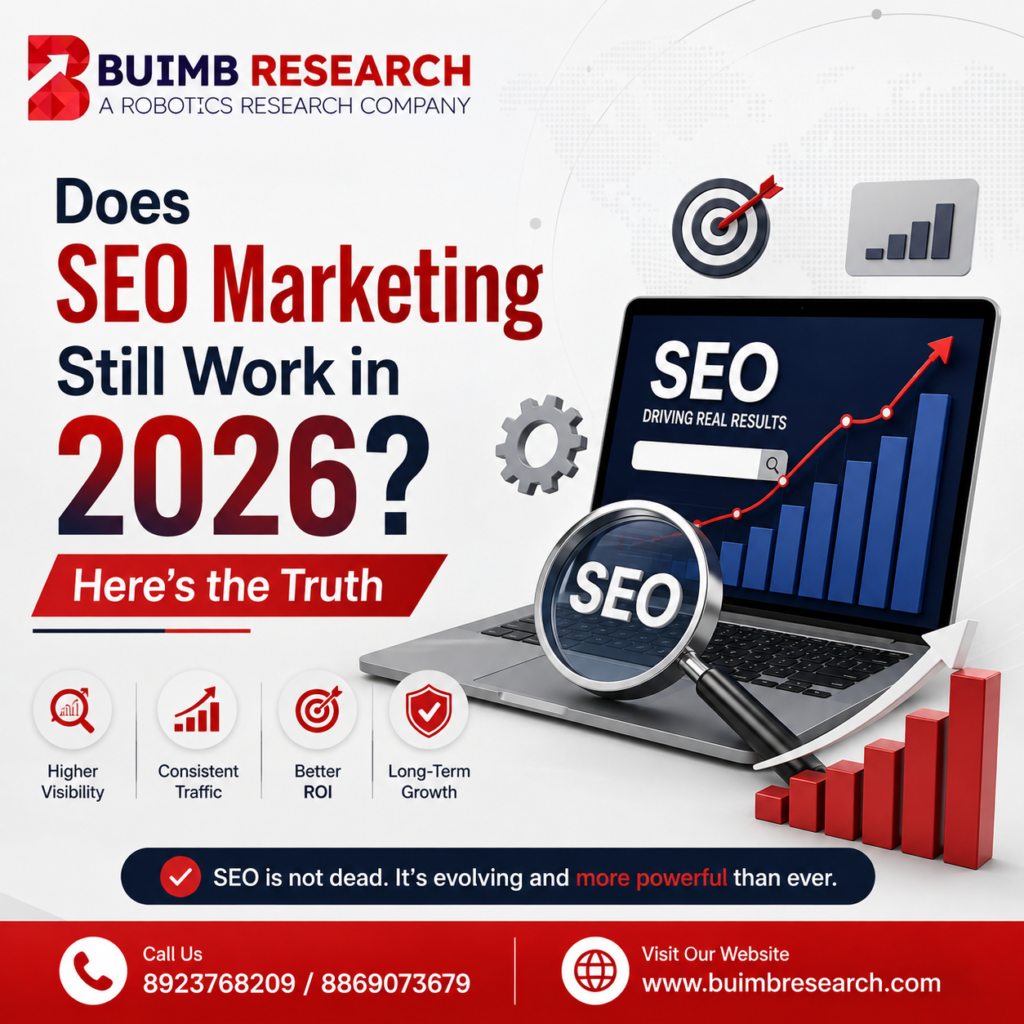
Does SEO Marketing Still Work in 2026? Here's the Truth
“SEO is dead” has become one of the biggest marketing myths of 2026. With AI tools like ChatGPT and Google AI Overviews changing how people search, many businesses are wondering if SEO is still worth investing in.
The reality is simple: SEO isn’t dead—it’s evolving. While outdated tactics no longer deliver results, businesses that focus on high-quality content, user experience, and authority continue to rank, attract qualified traffic, and generate leads. AI may have changed the way people find information, but it still relies on trusted, well-optimized websites.
In this blog, we’ll explore what has changed, what still works, and how businesses can adapt their SEO strategy to stay visible and competitive in 2026.
Connect with us to explore how the right digital marketing strategy can accelerate your business growth.
What Is SEO Marketing, and Why Is Everyone Suddenly Questioning It?
SEO marketing (Search Engine Optimization marketing) is the practice of improving a website’s visibility on search engines like Google so that it attracts organic, non-paid traffic. Traditionally, this meant targeting keywords, building backlinks, writing blog content, and optimizing technical elements like page speed and mobile-friendliness. The core promise of SEO marketing has always been simple: instead of paying for every visitor through ads, you earn consistent, compounding visibility by being the most relevant and trustworthy answer to what people are searching for.
That’s still true in 2026 — but the definition of “search” itself has quietly expanded. Search used to mean typing a query into Google or Bing and scanning ten blue links. Today, “search” also includes typing a question into ChatGPT, asking Gemini inside your Android phone, asking Perplexity for a sourced answer, or even asking Alexa a voice query. SEO marketing in 2026 has to account for all of these surfaces, not just the classic Google results page.
The doubt around SEO marketing in 2026 comes from one major shift: AI-powered search. Tools like ChatGPT, Google Gemini, Microsoft Copilot, and Perplexity are now answering user queries directly, without the searcher ever clicking through to a website. Google’s own AI Overviews sit right at the top of search results, summarizing answers before a single blue link appears. For certain informational queries — “what is,” “how to,” “best way to” — a growing share of users now get their answer without visiting any website at all.
This has led to what the industry now calls “zero-click search” — and it’s a real and measurable trend. Marketers have watched click-through rates for top informational keywords decline as AI-generated summaries answer the question directly on the results page. But zero-click search doesn’t mean SEO marketing has stopped working. It means SEO marketing has expanded into new territory — one where being cited by an AI system, or appearing inside an AI Overview, is now just as valuable as a traditional click, because it still builds brand awareness, trust, and recall even without a visit.
The Truth: SEO Marketing Isn’t Dying, It’s Evolving
Industry data backs this up clearly. A large majority of SEO professionals — figures cited in recent industry surveys put it as high as 86% — now use AI tools as part of their day-to-day SEO marketing workflow, not as a replacement for it. Marketers aren’t abandoning SEO; they’re using AI to do it faster and smarter, while keeping human judgment in the driver’s seat for anything that affects trust, accuracy, or brand credibility.
Here’s what that “evolution” actually looks like in 2026:
1. Generative Engine Optimization (GEO) Has Joined Traditional SEO
The biggest shift in SEO marketing this year is the rise of GEO — Generative Engine Optimization. This is the practice of structuring your content so that AI systems like ChatGPT and Gemini can find it, understand it, and cite it when generating answers to user queries. If your content isn’t structured clearly with real facts, proper headers, and citable data, you simply won’t get mentioned in AI-generated answers — no matter how good your traditional SEO marketing is.
In practice, this means SEO marketing in 2026 requires you to write for two audiences at once: the human reader and the AI system summarizing your page.
2. E-E-A-T Is the Real Ranking Factor Now
E-E-A-T (Experience, Expertise, Authoritativeness, Trustworthiness) has been a Google guideline for years, but in 2026 it has become the single most important trust signal in SEO marketing. Google — and AI search tools by extension — now reward content that shows a real author, real experience, and real proof behind every claim.
This is why generic, AI-spun blog posts with no original insight are quietly losing rankings, while content with genuine author bios, case studies, and original data continues to perform. If your SEO marketing strategy still relies on thin, templated content, 2026 is the year that stops working.
3. Structured Data Has Become Non-Negotiable
Structured data (schema markup) has existed for a long time, but it has become a central focus of SEO marketing in 2026. Structured data helps search engines and AI models understand exactly what your page is about — your business type, your services, your reviews, your FAQs — which directly affects whether you get pulled into AI Overviews and rich search results.
4. Branded Search Is Now an SEO Signal, Not Just a Marketing Metric
When people search your brand name directly — “BUIMB Digital reviews,” “BUIMB Digital pricing” — it signals trust to both Google and AI search tools. It tells the algorithm that people already know who you are and are actively seeking you out, which is one of the strongest trust signals a business can have. In 2026, building brand recognition through consistent presence across platforms — social media, review sites, community forums like Reddit and Quora — has become part of core SEO marketing strategy, not a separate “branding” activity.
This shows up in a very practical way: businesses that were once purely chasing generic keywords (“SEO agency,” “digital marketing services”) are now investing equally in getting their brand name talked about — through PR, podcasts, guest interviews, and customer reviews — because branded search carries far higher intent and conversion potential than cold, generic traffic.
5. Success Metrics Are Changing
Because of zero-click search, pure organic traffic numbers no longer tell the full story of whether your SEO marketing is working. In fact, several industry analyses now describe SEO as shifting away from being purely a traffic-acquisition channel and toward being a broader visibility and trust-building channel. Smart businesses in 2026 are tracking a mix of:
- Organic traffic and keyword rankings (still important, but no longer the only measure of success).
- Brand mention share across AI platforms — how often you’re named when someone asks an AI tool a relevant question.
- Conversion quality of the traffic that does click through — fewer but more intent-driven visitors, since users who do click through AI-mediated search tend to be further along in their decision process.
- Visibility in AI-generated answers and featured snippets — a newer, harder-to-track but increasingly important form of exposure.
- Assisted conversions and multi-touch attribution — recognizing that a customer might discover you via an AI answer, but convert weeks later through a direct visit or branded search.
This shift means agencies and business owners running SEO marketing campaigns in 2026 need to stop treating a dip in raw click numbers as automatic proof that “SEO isn’t working” — it may simply mean visibility is happening in places traditional analytics tools don’t fully capture yet.
Why SEO Marketing Still Matters for Indian Businesses in 2026
For small and medium businesses in India — whether you’re a local service provider in a city like Haldwani or a growing e-commerce brand — SEO marketing remains one of the highest-ROI channels available, for a simple reason: intent. Someone searching “digital marketing agency near me” or “best SEO marketing services in [your city]” is already looking to buy. No paid ad budget can replicate that level of intent at that cost, and unlike ads, the visibility you build through SEO marketing keeps working for you long after you stop actively “paying” for that specific piece of content.
India’s internet user base continues to grow rapidly, and a large share of that growth is happening through mobile-first, voice, and regional-language search. Tier-2 and Tier-3 cities — places like Haldwani, Bareilly, and similar growing markets — are seeing some of the fastest growth in local online search behavior in the country, as more small businesses and their customers move online. This creates a real opportunity: local competition for search visibility in these markets is often far lower than in metro cities, meaning a well-executed SEO marketing strategy can win top rankings faster and more affordably than in Delhi, Mumbai, or Bengaluru.
A few India-specific realities that should shape your SEO marketing approach in 2026:
- Mobile-first is not optional. The overwhelming majority of Indian search traffic happens on mobile devices, so page speed, mobile usability, and click-to-call/WhatsApp buttons directly affect SEO marketing performance.
- Regional and Hinglish search queries matter. Many Indian users search in a mix of English and their regional language (“best digital marketing company Haldwani mein,” “SEO services near me kaise milegi”). Ignoring these natural search patterns means missing a meaningful chunk of real search demand.
- Google Business Profile is a local SEO marketing essential, not an afterthought — for any business serving a local area, an optimized, regularly updated, review-rich Business Profile often drives as much value as the website itself.
- Voice search is rising alongside AI search. Many users, especially outside metro cities, are increasingly using voice assistants in regional languages, which favors content written in a natural, conversational, question-and-answer style rather than stiff, keyword-stuffed text.
This means SEO marketing strategies that ignore local search, Hindi/regional keyword variations, and Google Business Profile optimization are leaving real business on the table in 2026 — especially for businesses trying to grow beyond a single city or district.
How to Make SEO Marketing Work for You in 2026
If you’re wondering how to actually put this into practice, here’s a practical checklist — with the reasoning behind each step, so you’re not just following instructions blindly.
1. Focus on 3–5 Core Topics You Can Genuinely Own
One of the biggest mistakes in SEO marketing today is trying to rank for 30 different keywords across unrelated topics. Search engines and AI models now favor topical authority — meaning they trust sites that go deep on a narrow set of subjects over sites that go wide but shallow.
In practice, this means picking 3–5 “pillar” topics that are core to your business — for example, if you run a digital marketing agency, your pillars might be “local SEO,” “social media management,” and “Google Ads strategy.” Around each pillar, build a cluster of supporting blog posts, FAQs, and case studies that all interlink. This structure signals to Google (and to AI systems scanning your site) that you’re a genuine expert in that space, not a content farm chasing traffic.
2. Add Real Proof to Every Page
Generic content with no verifiable backing is losing ground fast. Every important page on your site — service pages, blog posts, landing pages — should carry visible proof of expertise:
- Author name and a short bio explaining why that person is qualified to write on the topic (years of experience, certifications, past clients).
- Original examples or mini case studies — even a two-line result like “helped a Haldwani-based retailer grow local search traffic by 40% in 4 months” adds far more trust than a generic claim.
- Location- or industry-specific data — using real numbers relevant to your market (e.g., Indian search behavior stats, regional competition insights) instead of only citing global data that doesn’t reflect your audience.
- Review and testimonial snippets placed near key claims, so readers don’t have to take your word for it.
This is what search engines mean by E-E-A-T in action — it’s not a checkbox, it’s visible, checkable proof on the page itself.
3. Use Structured Data (Schema Markup) on Key Pages
Structured data is code added to your website (usually in JSON-LD format) that explicitly tells search engines what your content means — not just what it says. For SEO marketing in 2026, this has moved from “nice to have” to essential, because AI systems rely heavily on structured data to pull accurate information into AI Overviews and chatbot answers.
Priority pages to add schema to:
- Service pages — using Service or LocalBusiness schema so Google understands exactly what you offer and where.
- FAQ sections — using FAQPage schema, which can help your answers appear directly in search results and AI summaries.
- Reviews and ratings — using Review or AggregateRating schema to display star ratings directly in search listings.
- Articles/blogs — using Article schema with author and publish-date details to reinforce credibility signals.
You don’t need to hand-code this — tools like Google’s Structured Data Markup Helper, Rank Math, or Yoast (for WordPress) can generate it for you.
4. Write Content That AI Can Cite
If you want your content to show up when someone asks ChatGPT, Gemini, or Perplexity a question, it needs to be written in a way these systems can easily extract and cite. That means:
- Clear, descriptive headers (like the ones in this blog) that directly match how people phrase questions — “How to make SEO marketing work in 2026” instead of vague headers like “Getting Started.”
- Direct answers early in each section, followed by supporting detail — AI systems tend to pull the first clear, factual sentence under a heading.
- Well-organized facts and lists (bullet points, numbered steps, tables) rather than long unstructured paragraphs, since these are easier for AI models to parse and quote accurately.
- Original data or insights that aren’t available elsewhere — AI systems are more likely to cite a source that adds something unique rather than one that repeats common knowledge.
5. Build Genuine Brand Mentions, Not Just Backlinks
Backlinks still matter, but in 2026, SEO marketing has expanded to include brand mention share — how often your business name shows up across the internet, even without a link attached. AI systems and Google both use this as a trust signal.
Practical ways to build this:
- Get featured in industry roundups, local news, or guest posts (like a genuine, well-placed contribution rather than a spammy link-drop).
- Encourage and respond to reviews on Google Business Profile, Justdial, and industry-specific platforms.
- Participate authentically in community platforms like Reddit, Quora, and relevant Facebook/LinkedIn groups — real answers, not promotional spam.
- Build partnerships with complementary local businesses for co-marketing and cross-mentions.
6. Track New KPIs Beyond Just Clicks
Because zero-click search is rising, judging your SEO marketing purely by organic traffic numbers gives an incomplete picture. In 2026, a more complete measurement dashboard includes:
- Traditional metrics: organic sessions, keyword rankings, organic conversions.
- AI visibility metrics: whether your brand or content is appearing in AI Overviews or being cited by tools like ChatGPT (you can spot-check this manually by asking relevant questions in these tools).
- Branded search volume: growth in people searching your business name directly — a strong trust indicator.
- Lead quality over lead volume: fewer, more qualified inquiries often matter more than a spike in raw traffic, especially for service businesses.
7. Keep a Human in the Loop for AI-Assisted Content
AI tools are now a standard part of SEO marketing workflows — for research, outlining, and first drafts. But content published without human review is increasingly easy for both readers and search algorithms to spot, and it can quietly damage trust and rankings.
Before publishing any AI-assisted content, run it through a simple quality check:
- Fact-check every claim and statistic against a primary source.
- Verify examples and data are accurate and relevant to your actual business or market — not generic filler.
- Add a real author’s perspective or experience somewhere in the piece, so it doesn’t read as fully automated.
- Edit for natural tone and local context — especially important for Indian audiences, where phrasing, examples, and cultural references need to feel authentic rather than templated.
Treat AI as a drafting assistant, not a publisher. The final judgment on accuracy and trustworthiness should always rest with a person.
Common SEO Marketing Mistakes That Are Costing Businesses in 2026
Even businesses that are actively investing in SEO marketing often undercut their own results with a handful of avoidable mistakes. Watch out for these:
- Chasing traffic volume instead of intent. Ranking for a keyword that brings 5,000 visitors a month means little if none of them are looking to buy. A smaller, more targeted keyword strategy usually outperforms a broad one.
- Publishing fully AI-generated content with zero human review. As covered above, this is now easy to detect — both for readers and for search algorithms — and it actively damages trust signals.
- Ignoring technical SEO basics. Slow page load times, broken links, missing alt text, and poor mobile experience can undo even the best content strategy. Structured data and great content can’t compensate for a technically broken website.
- Treating SEO marketing as a one-time project. Search algorithms, AI models, and competitor strategies all change constantly. A “set it and forget it” approach quietly loses ground month after month.
- Neglecting local signals for a local business. Skipping Google Business Profile optimization, local citations, and location-specific content is one of the most common — and most costly — mistakes for city-based service businesses.
- Over-optimizing for keywords at the expense of readability. Keyword stuffing was a weak strategy even in 2015; in 2026, it actively hurts both human trust and AI citation potential, since unnatural, repetitive text is exactly what these systems are trained to deprioritize.
Final Verdict: Is SEO Marketing Worth It in 2026?
Yes — unambiguously. SEO marketing in 2026 is not dead; it has matured into something broader that includes traditional search, AI search (GEO), and brand visibility all at once. Businesses still running an SEO marketing playbook from 2020–2022 will feel like they’re losing ground, because they are. But businesses that adapt — by prioritizing genuine expertise, structured content, and real trust signals — are seeing SEO marketing deliver stronger, more qualified results than ever before.
The rules have changed. The value hasn’t.
References
- HubSpot — SEO Trends for 2026: How Search and AI Are Changing
- FourFront — SEO and Digital Marketing Trends for 2026
- TheeDigital — SEO Trends 2026: SEO Transformation and AI Impact
- Digital Elevator — SEO and Content Marketing Trends for 2026
- Wowbix — SEO & Content Marketing Trends for 2026: What Works Now
- Evergreen Media — SEO Trends 2026: Developing Strategies for the AI Era
- Circles Studio — 2026 SEO Trends and What It Means for Your Business
- Envisionit — 15 SEO Trends You Can’t Ignore in 2026
Connect with us to explore how the right digital marketing strategy can accelerate your business growth.
Q1. Is SEO marketing dead because of AI Overviews and ChatGPT?
No. SEO marketing has changed, not ended. AI tools still rely on well-optimized, credible web content to generate their answers, which means strong SEO marketing is now a prerequisite for AI visibility too, not a separate strategy.
Q2. How long does SEO marketing take to show results in 2026?
Timelines haven’t changed dramatically — most businesses still see meaningful movement in 3 to 6 months, with stronger compounding results after 6 to 12 months of consistent effort. What has changed is that results now show up across more channels (AI answers, brand mentions, local search) in addition to traditional rankings.
Q3. Should small businesses still invest in SEO marketing, or focus only on paid ads?
For most small and local businesses, SEO marketing remains the better long-term investment, because visibility keeps compounding even after you stop actively creating new content, whereas paid ads stop delivering the moment you stop paying. A blended approach — ads for immediate visibility, SEO marketing for sustainable growth — tends to work best.
Q4. What's the single most important SEO marketing priority for 2026?
If you can only focus on one thing, focus on genuine E-E-A-T: real expertise, verifiable proof, and content written by people who actually understand the subject. Every other tactic in this blog — structured data, GEO, branded search — works better on top of that foundation, not instead of it.